
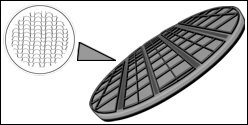
What are mist eliminators?
Knitted mesh mist eliminators are porous blankets of knitted, layered or rolled stainless steel mesh designed for effective removal of entrained liquid from vapour.
They can be fabricated in any size and shape, then installed in new or existing vessels.
Advantages & benefits
- Improve process efficiency
- Increase throughput capacity
- Reduce air-pollution problems
- Eliminate loss of product
- Improve product quality
- Reduce product contamination
How they operate
Vapour and entrained liquid pass through the knitted mesh. The vapour moves easily, but the liquid - because of the density of the mesh - contacts the wire surfaces and holds. As volume collects, droplets grow, follow the wire to the bottom of the mesh and fall, while the vapour proceeds upward.
Applications of the knitted mesh
Scrubbers, separators & knock-out drums
Removes oil and water from compressed air; removes hydrocarbon liquids from natural gas.
Evaporators
Produces condensate suitable for boiler feed water.
Absorbers
Removes almost all liquid entrainment of process liquids for clean, dry gas with increased efficiency.
Refineries
Used in vacuum towers and lube towers.
Sulphur plant coalescers
Removes sulphur mist from the acid-gas stream in sulphur condensers and gas scrubbers.
Steam drum
Prevents water carry-over to turbines; provides clean, dry steam.
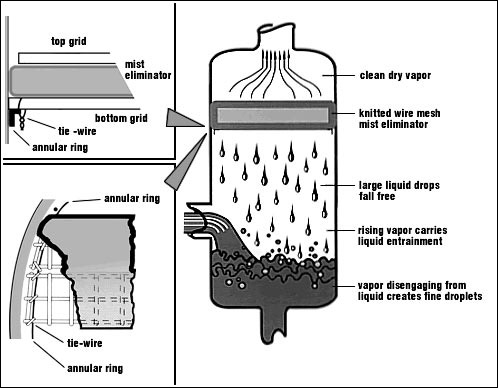
Knitted mesh construction
Construction is not limited by size or shape. For larger equipment, where one piece is not practical, sectional mesh pads are used. Pads of 4" or 6" thickness are most common; thickness can exceed 6" if required. In smaller equipment, one-piece pads provide the most convenient installation - diameters usually limited to a maximum of 42", thickness normally 4" to 6".
Data required
| Vapour velocity | Process or system description |
| Operating pressure | Surface tension |
| Vapour density | Materials of construction |
| Operating temperature | Liquid viscosity |
| Liquid density | Performance requirements |
Special conditions
Where entrainment of less than 5 microns must be removed, two units can be installed in series - the first collects mist into large droplets, easily removed by the second. Where coking is a potential problem, variable-density mist eliminators can be used: larger openings in the lower section resist clogging, finer openings in the upper section provide excellent separation.
Materials
Stainless steel - 304L, 316L and others.
Special alloys - Inconel, Monel and others.